
Excel vs. Bookkeeping Software: Deep Dive for Small Businesses
For decades, Microsoft Excel has been the Swiss Army Knife for entrepreneurs. It is familiar, it is flexible, and—perhaps most appealingly—it feels “free.” When you launched your venture, opening a spreadsheet to track income and expenses was likely your very first step for your small business accounting.
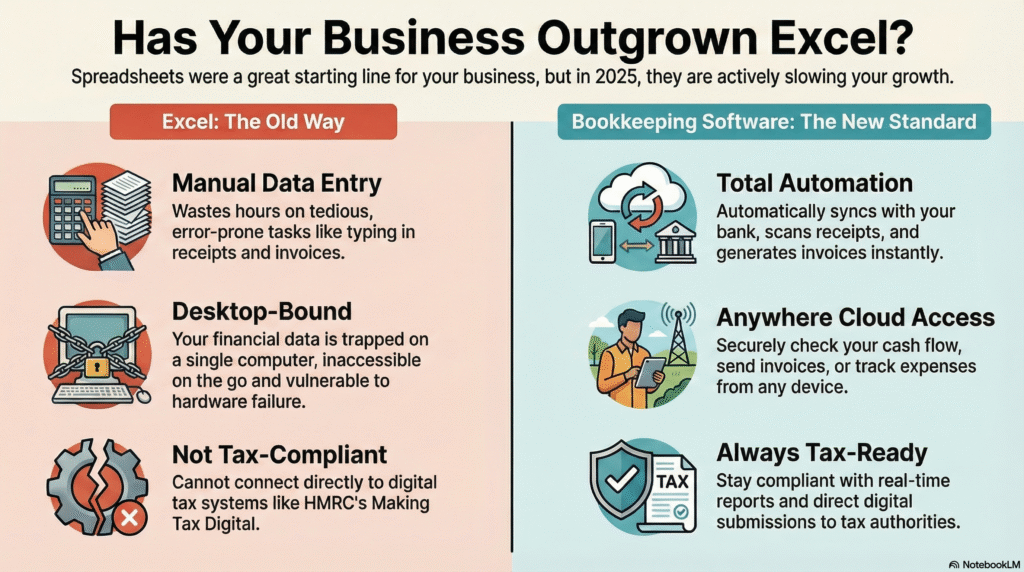
But as we move into 2025, the landscape has shifted. Tax regulations are tighter, transaction volumes are higher, and the need for real-time data is critical. If you are still manually entering data into cells, you aren’t just managing your books; you are actively slowing down your growth. Here is the definitive breakdown of why it is time to graduate from spreadsheets to a dedicated bookkeeping small business software.
1. The “Hidden Cost” of Manual Entry
The biggest argument for Excel is that it costs nothing. But this ignores the most expensive asset you own: your time.
Manual bookkeeping via spreadsheets requires you to be the data entry clerk. Every receipt, invoice, and bank fee must be typed in by hand. It is tedious and prone to error.
In contrast, modern accounting software for small businesses automates data extraction from bills, receipts, and invoices. Further, the validations that are not present in Excel also make bookkeeping less prone to errors.
2. Accessibility: The “Desktop” Trap vs. Cloud Freedom
Excel usually lives on one computer. If that hard drive fails, your financial history will be lost. If you are out of the office and need to check a client’s payment status, you have to wait until you are back at your desk.
This is where online accounting software for small businesses changes the game. Cloud-based platforms ensure your data is backed up securely and accessible from anywhere.
With dedicated mobile accounting apps for business, you can snap a photo of a receipt at lunch, send an invoice from a taxi, or check your cash flow while waiting for a flight. In 2025, business owners must move fast and can not be tethered to a desktop.
3. Niche Complexity: One Size Does Not Fit All
Spreadsheets are generalists. They don’t know if you are a landlord or an e-commerce seller. Dedicated software, however, is built for specific industries.
For Retailers: If you sell on Shopify or Amazon, a spreadsheet cannot track real-time inventory or calculate Cost of Goods Sold (COGS) effectively. You need specialised ecommerce bookkeeping software that integrates with your store to automatically manage stock levels.
For Property Owners: Managing rental portfolios on Excel is a compliance nightmare, especially with new regulations. Using specific landlord accounting software in the UK ensures you correctly track rental yields and remain compliant with initiatives such as Making Tax Digital (MTD).
4. Compliance and “Making Tax Digital”
Speaking of tax laws, governments worldwide are digitising. In the UK, small business accounting software solutions are becoming a must-have to comply with MTD rules.
Excel cannot submit a VAT return directly to HMRC. A certified business bookkeeping software tool can.
5. Free vs. Paid: The Scalability Question
Many business owners hesitate to upgrade due to monthly subscription costs. They often look for free accounting software solutions for small businesses.
While free tools are a step up from Excel, they often lack critical features such as advanced reporting and multi-currency support. As you grow, you need a complete account package for your business that scales with you.
Conclusion
The benefits of small business accounting software over Excel are undeniable:
- Accuracy: No more broken formulas.
- Speed: Automated bank feeds and invoicing.
- Insight: Real-time Profit & Loss reports at the click of a button.
Excel was a great starting line, but it shouldn’t be your finish line. To survive and thrive in 2025, your financial foundation needs to be automated, secure, and compliant.